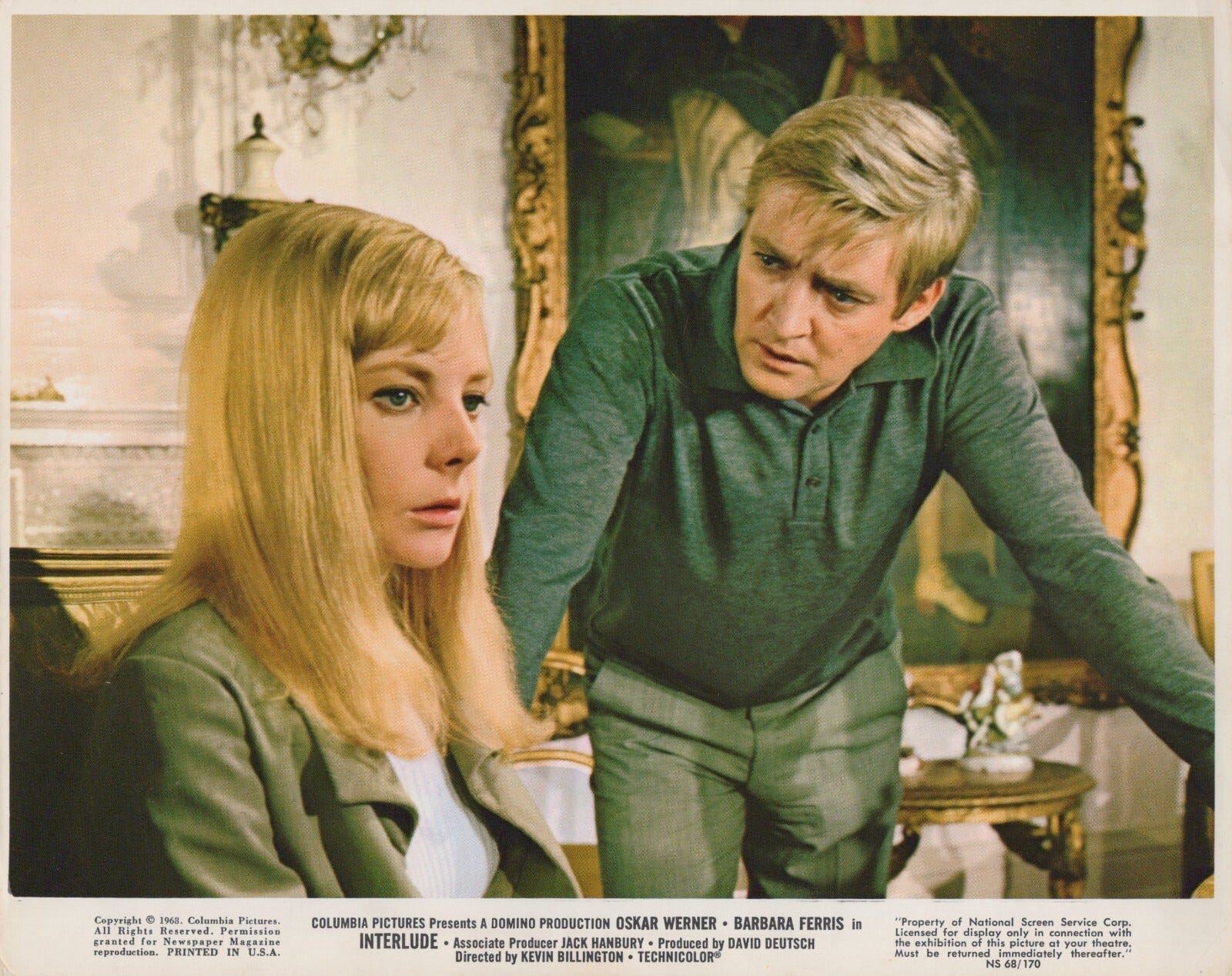
Interlude (1968)
'Their love could never be. She knew it. He knew it. So did his wife...'

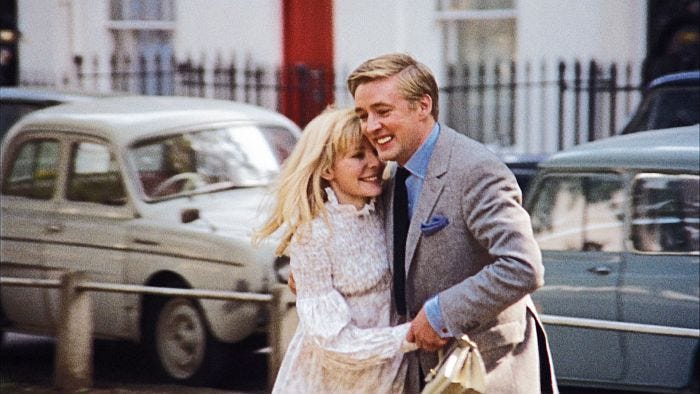
Wednesday’s regular foray into the WEEKEND FLICKS. archives continues with Kevin Billington’s Interlude (1968). Pull on your black polo neck — and handkerchiefs to the ready — as Oskar Werner’s smooth maestro woos a pretty young journalist against a backdrop of Swinging London and the Home Counties. The soundtrack includes Beethoven, Mozart, Tchaikovsky, Brahms, Rachmaninov and Albinoni. I’ve updated the original post with further links and fresh content:
Ahoy, there, Lovebirds! I've just rediscovered Interlude (1968). It's currently on YouTube. Good news for us British 1960s film fans, as unless you happened to have a video recording, previously the only way to watch it was via an expensive DVD shipped over from America — which, in any event, was only going to work on American DVD players. One of the rules I set myself from the very beginning of WEEKEND FLICKS. Cinema for Grown Ups was that every film should be readily available. There's no point recommending a film if you can't watch it.
Interlude (1968) is Kevin Billington’s loose remake of Douglas Sirk’s film of 1957, transposed to Swinging London. Kevin Billington also directed the interesting (and possibly underrated) Voices (1973), starring David Hemmings and She-Who-Can-Do-No-Wrong Gayle Hunnicutt, a creepily good ghost story along a similar line to The Others (2001), with Nicole Kidman, and with similarities, in places, to Nic Roeg’s Don’t Look Now (1973) — but then it’s interesting how certain themes and ideas seem to catch the zeitgeist, so that a whole crop of films can appear at the same time with similar themes.
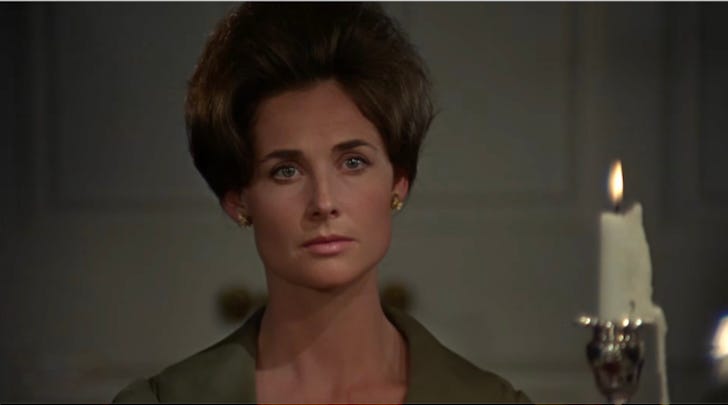
Interlude (1968) is about an illicit romantic liaison. Sally, a blonde, twenty-something, mini-skirted journalist (Barbara Ferris), begins an affair with Stefan Zelter (Oskar Werner), a world-famous, forty-something German conductor, married to Antonia, a perfect, oh-so-English Society wife played by the wonderful Virginia Maskell. That’s the plot. It’s a superior melodrama — actually, for those of us with limited brain capacity, not too difficult to grasp. And funnily enough, it also happened to be one of my late father’s favourite flicks. And like so many other films of this period, it’s intelligent, understated and beautifully made, with subtle casting, nostalgic locations and a cracking soundtrack, which apart from the music of French composer Georges Delerue, includes Beethoven’s Fifth, Mozart’s Adagio in C Major for Glass Harmonica (I think?), Tchaikovsky’s Symphony No. 1, Brahms’s Symphony No. 3, Rachmaninov’s Symphony No. 2 and Albinoni’s Adagio in G Minor.
Talking of the music, I would give my teeth (what’s left of ‘em) to identify the beautiful orchestral piece at 1:31, which isn’t listed in the credits but sounds like Vivaldi or Albinoni. I’m now more or less certain that it’s an uncredited Baroque pastiche by Georges Delerue, who came up with a similar Baroque number for Promise at Dawn (1970). If you know, please drop me a line.
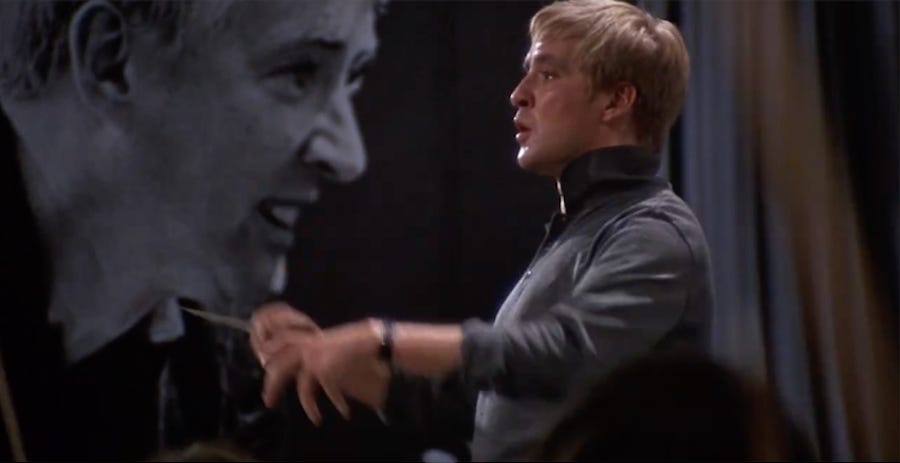
Oskar Werner's Stefan is terrific, marvellously convincing as a dynamic, thrusting, celebrity conductor (the man has rhythm!): a sort of cool, younger version of a von Karajan or a blonde Daniel Barenboim, a maestro for the Swinging Sixties, with a so-called 'Chinese Eye' drop-head Mulliner-Park-Ward bodied Continental Bentley in chocolate brown, an elegant Society wife, and a stuccoed wedding cake of a Regency country house, plus an ego as big as Beethoven's brow ("I'm surrounded by idiots!"). From memory, he doesn't wear a black polo neck, but if not, he should have done. A moody, sexy portrait shot for a Deutsche Grammophon LP sleeve.