
Moonraker (1979)
"At least I shall have the pleasure of putting you out of my misery..."

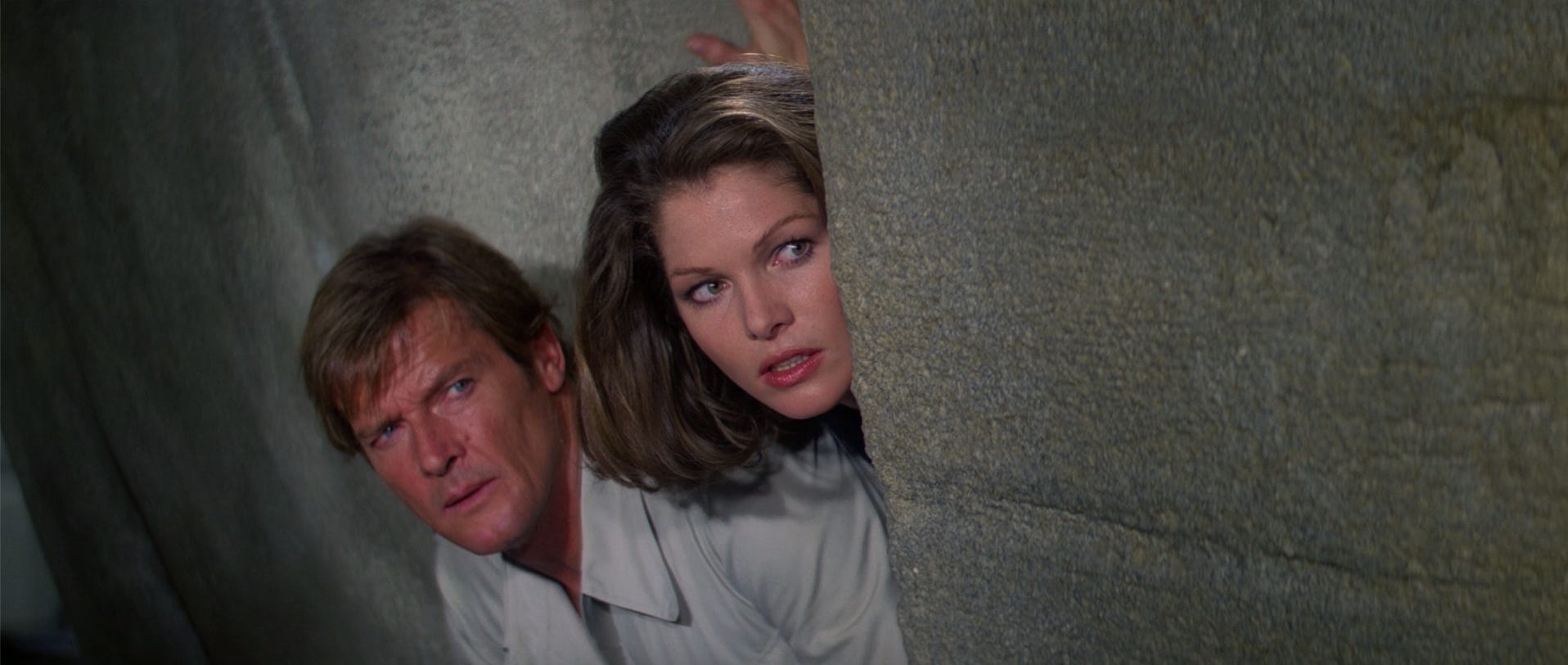
Right. Mister Bond. Where were we? So far, we’ve covered all the Bond films up to 1983, apart from For Your Eyes Only (1981), but including the maverick cuckoo in the nest, Never Say Never Again (1983). My personal favourite Bonds so far? On Her Majesty’s Secret Service (1969) — without any shadow of doubt. Followed by From Russia With Love (1963), Goldfinger (1964), the guilty pleasure which is The Man with the Golden Gun (1974) and Bank Holiday favourite, Live and Let Die (1973). Most probably ‘cos of the Voodoo.
For by now, if you’re a regular reader, you will know of my unfashionable views on the Bond franchise. Mixed feelings. I’m a considerable fan of Fleming’s original novels, published by Jonathan Cape between 1953 and 1965. And I’ve just started to re-read the lot, in order of publication, starting with Casino Royale. Literary Bond is a different beast from Cinematic Bond. Far darker. A cold, ruthless civil servant with a licence to kill, a finicky connoisseur with a physical price to pay: a brutal return for the luxury of Bond’s grim satisfaction — the food, the drink, the cars, the loveless sex and the seventy cigarettes a day; unmasking Fleming’s repressive Scottish Presbyterian streak. It’s almost sado-masochistic. And Fleming’s books are deadly serious, albeit tempered with a wry, dry-as-a-bone humour. I’m an admirer — to some extent — of the earlier films, but by the 1970s, Britain had changed. The oil crisis, the End of Empire, stagflation, the three-day week, shifting social mores, and the permissive society saw to that. Bond is an imperial dinosaur; the world had moved on. Roger Moore — bless ‘im — countered this with a knowing camp; comic end-of-the-pier stuff: saucy innuendo, a nod and a wink, chorus boys singing Nobody Does It Better. Seaside Special. A quip-a-minute, middle-aged wag propping up the bar at the Hilton; an ‘ironic’ Union Jack parachute. Which meant that by Octopussy (1983), Bond is dressed as a clown and eyeing up a tasty pair of knockers via a video screen on his Seiko wristwatch.
Which takes us to Lewis Gilbert’s Moonraker (1979). I saw it when it first came out, in the long, hot summer of 1979, on the big screen. In bucolic Wiltshire of all places, with some friends of my parents. My mother fell asleep halfway through (she finds Bond ‘boring’), and one of the grown-ups disappeared during the intermission to complain to the manager about the quality of the cinematic print. From memory, it did seem to have been one of Roge’s better outings, but does it live up to expectations today? I mean, surely, it can’t be as bad as Octopussy (1983), or for that matter, For Your Eyes Only (1981) or the dire A View to a Kill (1985)?
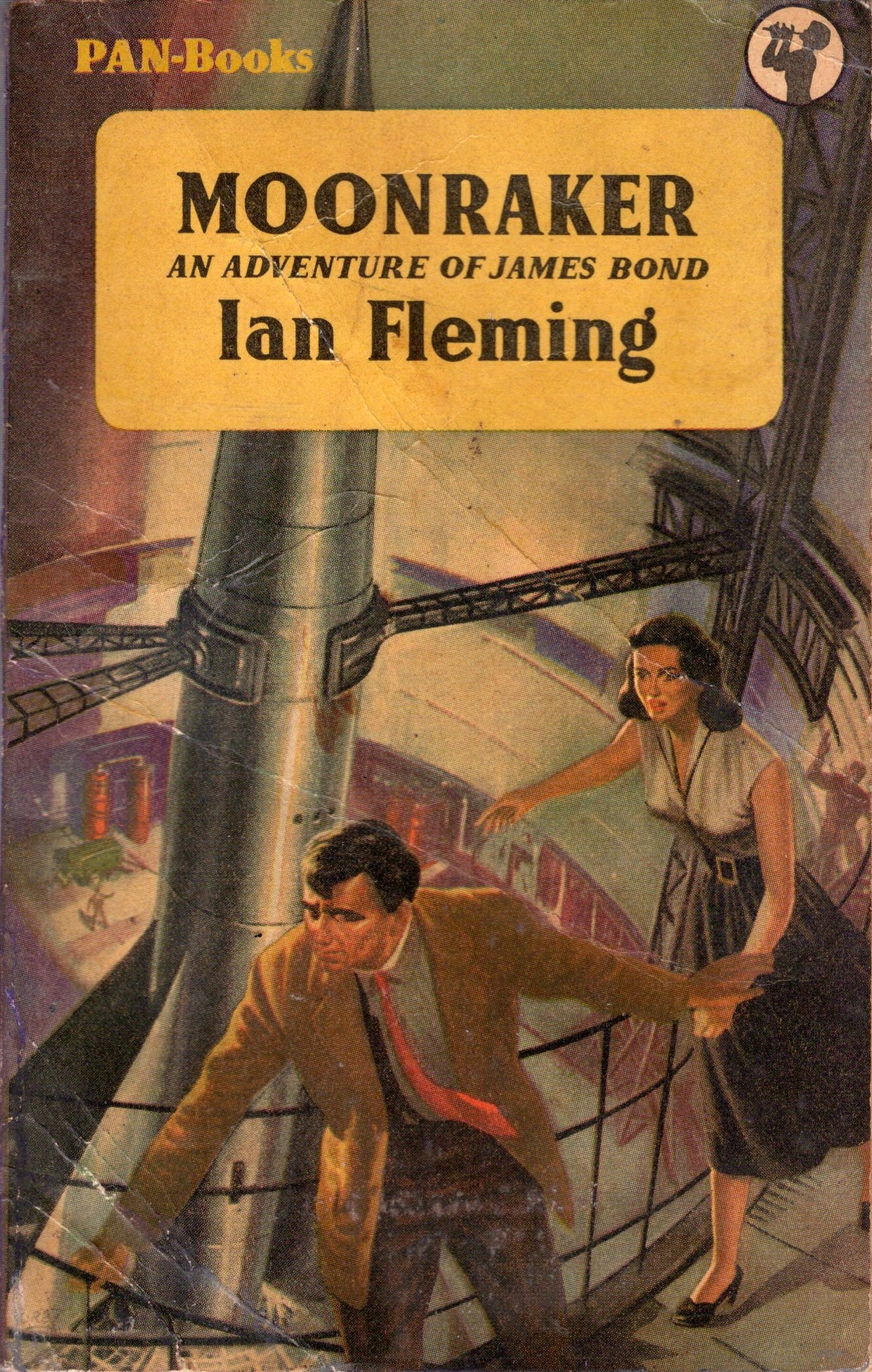
Moonraker was the third James Bond book, published in 1955, with a dust jacket apparently conceived by Fleming himself. Prompted by film producer Alexander Korda, Fleming developed his novel with the cinema in mind, even producing a script, which has recently changed hands for an undisclosed sum. Moonraker is set entirely in England, notably Kent — the Garden of England — Fleming’s favourite county (the man owned an Art Deco beach house in St Margaret’s Bay). Bond is sent to investigate Sir Hugo Drax, a sinister industrialist with a mysterious past, suspected of cheating at Bridge at Blades, no less, presumably based on Boodle’s, where Fleming was a member. Drax is building Britain’s first nuclear missile, the Moonraker, based on the German V2 rocket, which terrorised London in 1944. Sir Hugo turns out, actually, to be German, one Graf Hugo von der Drache. Even more worrying, he’s a dedicated Nazi, a man on a mission to destroy London, in revenge for being bullied at an English public school before the War. This is very much a product of the immediate post-war world, pre-Suez, with Britain in decline (more obvious in hindsight than at the time) but still a leading world power with considerable influence on the international stage.
Incidentally, the word ‘Moonraker’ is a traditional nickname for the good folk of Wiltshire (where Fleming’s wife, the former Ann Rothermere, built a grand neo-Georgian country house on a swamp). It’s slightly bizarre. According to the 18th-century antiquary, Francis Grose (1731-1791), Wiltshire yokels were in the habit of concealing barrels of smuggled cognac in village ponds. Caught red-handed by customs officials in the dead of night, their excuse was that they were merely raking the moonlight from the surface of the pond, because they thought it was cheese. It’s a typical piece of arcane Fleming lore. Like the College of Arms stuff in On Her Majesty’s Secret Service (1963) or Bloody Morgan’s gold in Live and Let Die (1954).
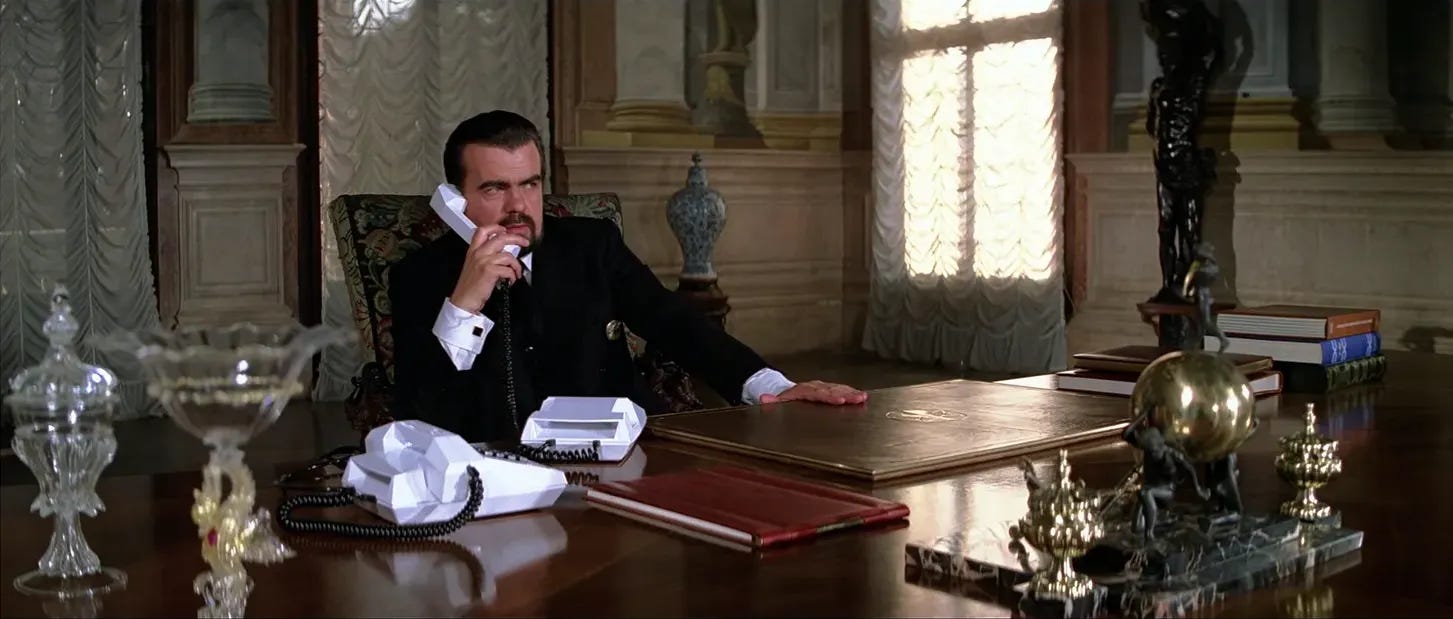
But how to translate an urbane 1950s thriller for a mass audience of the late 1970s? Moonraker, the film, is a different kettle of fish from Moonraker, the book. Hugo Drax (plain Mr, no Sir) has now become a sinister Californian tycoon with a goatee beard, a man who’s bought Vaux-le-Vicomte, and transported it brick-by-brick to sunny California, where he’s building a series of Moonrakers: Late 1970s Space Shuttles. Michael Lonsdale, who plays Drax, is superb. Steals the show. One of the best Bond villains out there, in the tradition of the literary Fleming. Dry as a camel’s fart, with a deadpan delivery and all the best lines, but then Christopher Wood, of Confessions of a Window Cleaner (1971) fame, wrote the script:
You have arrived at a propitious moment, coincident with your country's one indisputable contribution to Western civilisation: Afternoon tea. May I press you to a cucumber sandwich?
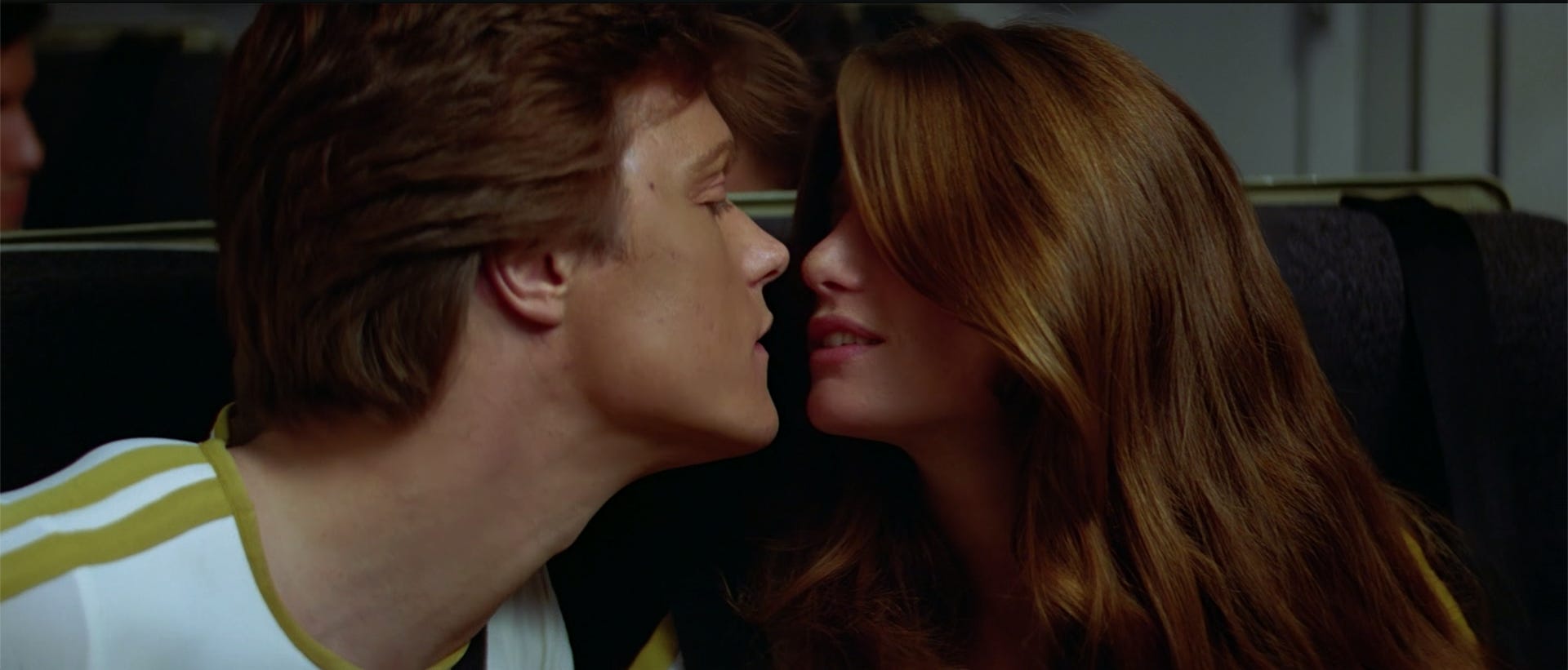
And the Nazi, Nietzschean, Darwinian ‘Survival of the Fittest’ element is still there. Dastardly Drax has this megalomaniac God fixation. A plan to wipe out the entire population of Earth with fifty pods of Amazonian nerve gas launched from his secret space station in orbit, to be replaced by six space shuttles' worth of hand-selected, 1970s beautiful people, perfect specimens with blow-dried hair. Like The Love Boat in space. Look, I’m not exactly having sleepless nights over this, but it does worry me that if there are only six space shuttles, and say twenty dewy-eyed couples inside each shuttle, that means that, if I’ve done my maths right, Earth will have to be repopulated with a mere 240 people, which means that, logically, there’s going to be one hell of a lot of nookey going on for the planet to survive. But hey, maybe that’s part of Drax’s devious scheme? It’s all a little bit pervy:
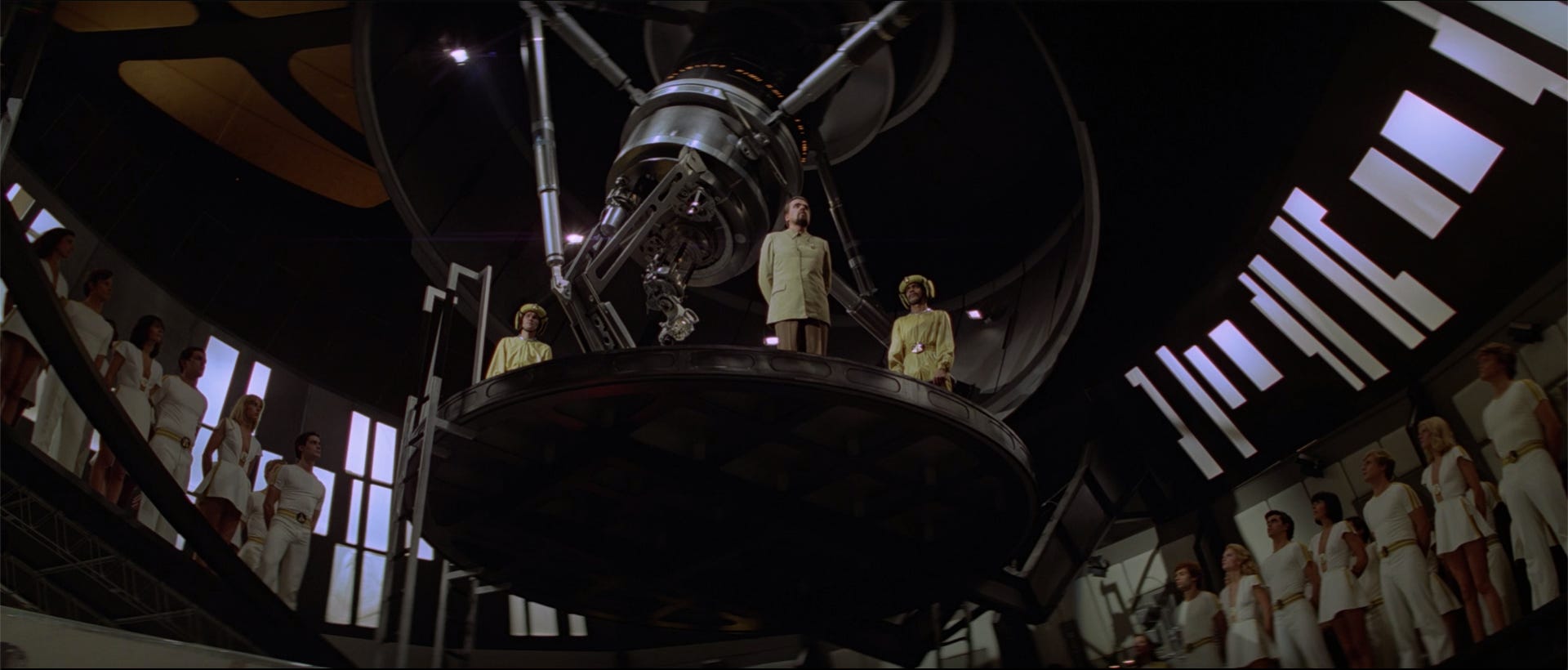
First there was the dream, now there is reality. Here, in the untainted cradle of the heavens, will be created a new super race, a race of perfect physical specimens. You have been selected as its progenitor; like Gods, your offspring will return to Earth, and shape it in their image. You have all served in public capacities in my terrestrial empire. Your seed, like yourselves, will pay deference to the ultimate dynasty which I alone have created. From their first day on Earth they will be able to look up and know that there is law and order in the heavens.
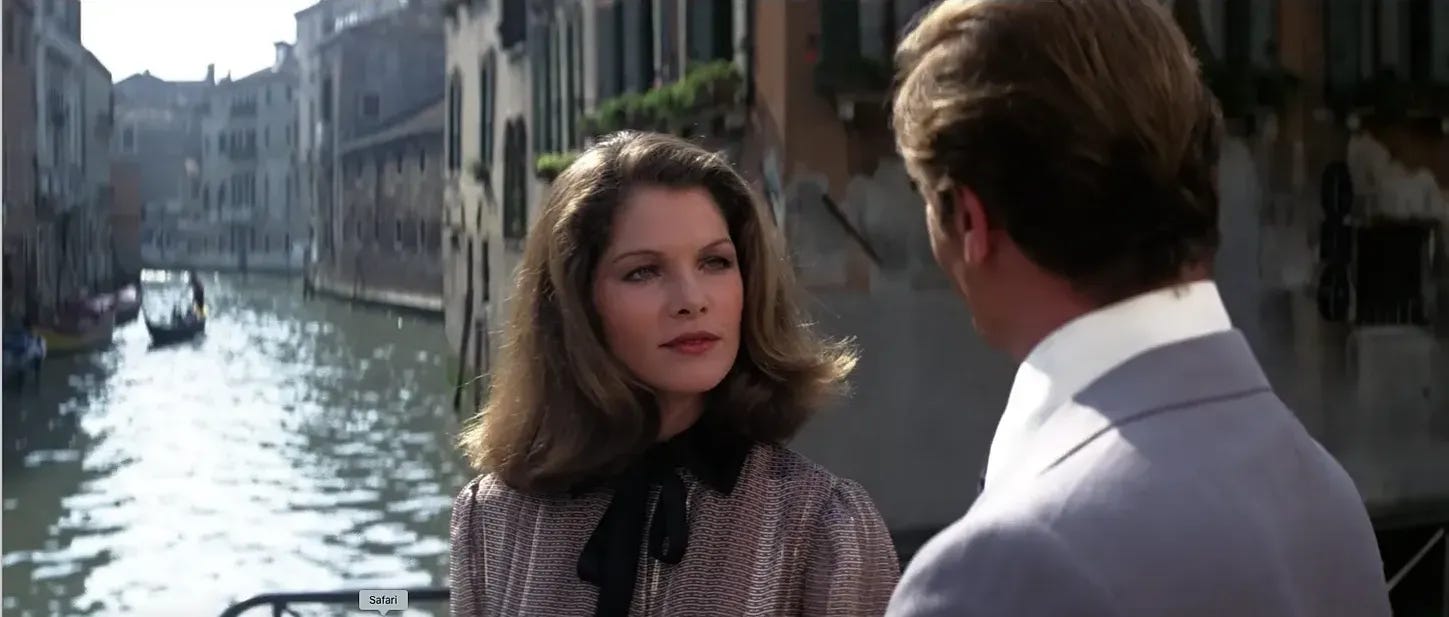
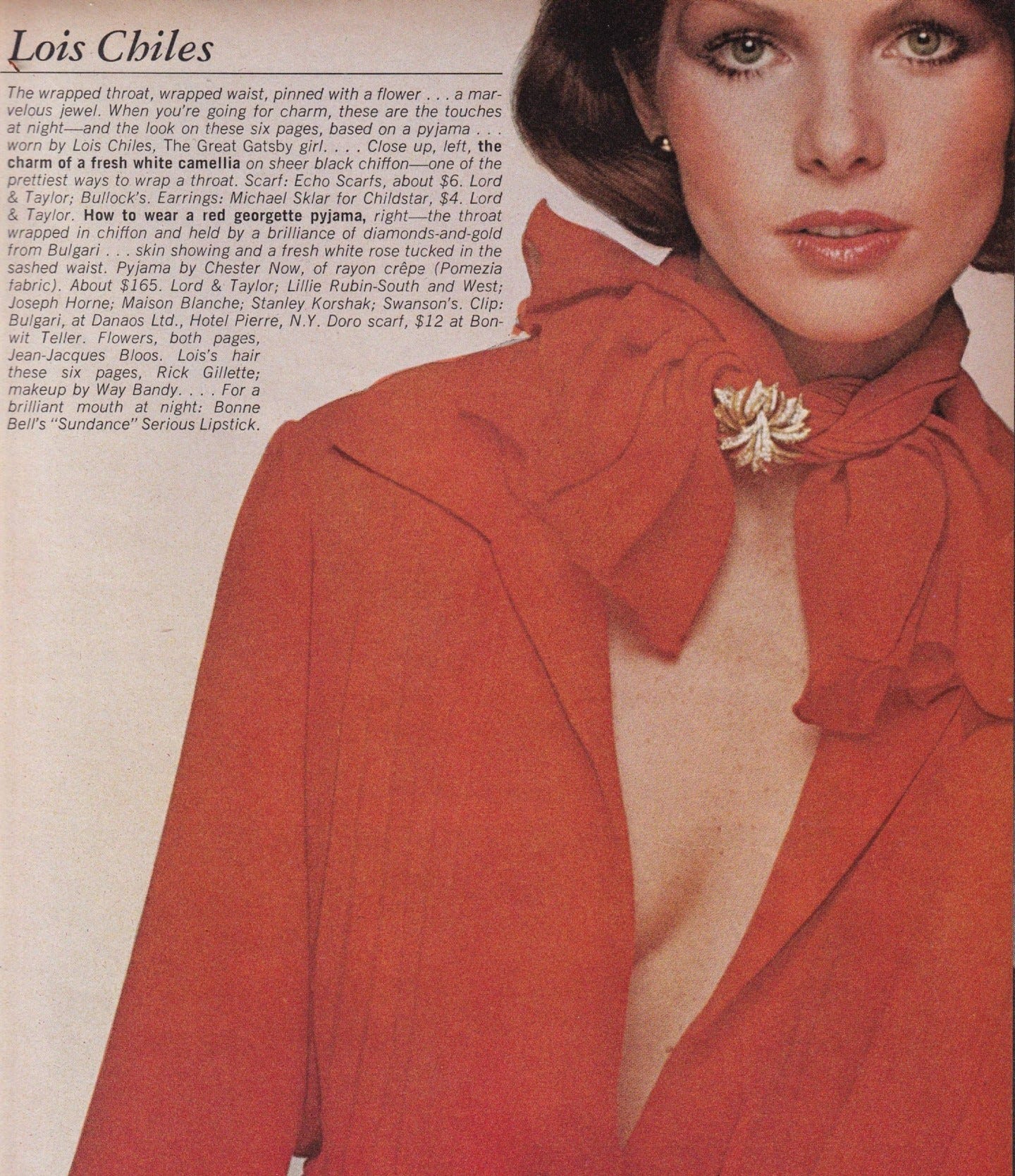
Talking of the 1970s beautiful people, we must now turn our attention to brainy astronomical physicist, Dr Holly Goodhead, played by the fabulous Lois Chiles. Lois’s a dish. I suppose most people today will remember Chiles for Moonraker (or perhaps Death on the Nile (1978) or Dallas (1978-1981)), but back in the early-to-mid 1970s, Lois was a seriously hot property. Texas beauty queen turned cover girl, a super-sophisticated New York fashionista and muse, hobnobbing with the likes of Andy Warhol and Tennessee Williams, photographed by Francesco Scavullo for Vogue, and captured by Ron Galella kissing Yves Saint Laurent at the Pierre Hotel fashion show in 1974. Before Studio 54 opened in the Spring of 1977, when the it crowd danced the night away at Le Jardin (which opened in 1973) and Le Club, New York’s first members-only discothèque. Chiles, of course, is also remembered for her performance as Jordan Baker in Jack Clayton’s The Great Gatsby of 1974. As much as I love this film, for so many different reasons, she’s probably miscast. She’s far too glamorous. Arguably even more glamorous than Mia Farrow, when Daisy’s supposed to be the girl everybody’s in love with. Nick Carraway is supposed to be rather ambiguous — Fitzgerald makes that clear in his text — and Jordan should really be more of the Betjeman-esque golfer, with boyish looks, ‘a young cadet.’
But what of Bond? Roger’s fifty-one in Moonraker, to Lois’s thirty-two. And he gets away with it, still looking reasonably svelte in his Italian Angelo Roma suits (not really Fleming, that) and his splendid shirts by Pall Mall’s Frank Foster, the London shirtmaker, even if his black shirt, high-waisted trouser combo — up to his nips — is decidedly dodgy. But the fight scene in the Venini glass shop in San Marco, Venice, has to be one of the better Bond fights of the series, with 007 confronting Toshiro Suga, a genuine martial arts expert. That’s a very 1970s thing. The obsession with Kung Fu, even if, by 1979, it was almost old hat. What I’m less happy about is Bond’s ridiculous, motorised gondola, in which he burns up St Mark’s Square with yobbish handbrake turns. Seriously, it’s as bad as one of those naff super cruisers which the poor Venetians have to put up with today, you know the things: those giant plastic washing-up tubs which dwarf the lagoon. The disembarkation of the gormless. The waddling hordes who jam the canals but never buy anything, or spend any money, apart from some dubious Murano glass. Even the postcard, thanks to the iPhone, is now more-or-less a thing of the past.
And I struggle to get my head around Jaws, a character who strikes me as decidedly silly. A serious style miss. Although I suppose if you were an orthodontist, there might be some marketing traction in his braces. Like Italy at the end of the Second World War, Jaws (Richard Kiel) changes sides and becomes one of the good guys. Suddenly, he’s Bond’s best buddy, despite the fact that over the last few years, Jaws has tried his very best to kill him in the most devious and dastardly ways — at least since The Spy Who Loved Me (1977). And that’s another thing. Aside from the noticeable, incessant in-your-face product placement (7-Up, British Airways, Harrods, Christian Dior, Marlboro), there’s constant referencing to other blockbusters of the period. We can start with Jaws. Presumably a nod to the shark extravaganza of 1975? Then Corinne Cléry gets chased by a pair of ravenous Rottweilers through a forest in a Whistler-white dress, like something from The Omen (1976), or at least a 1970s horror B-movie. And the entry code to the secret nerve factory, housed in a Venetian palazzo, is that irritating beeping theme from Close Encounters of the Third Kind (1977), which created a tiresome craze in the playground. There’s also a South American segment with Bond dressed as a gaucho, in the manner of The Magnificent Seven (1960), a cable car sequence suspiciously similar to a scene in Where Eagles Dare (1968), and the space bits are an obvious answer to the kidults’ favourite, Star Wars (1977). But then so much of Moonraker is its own nick. From all the other previous Bond films put together.
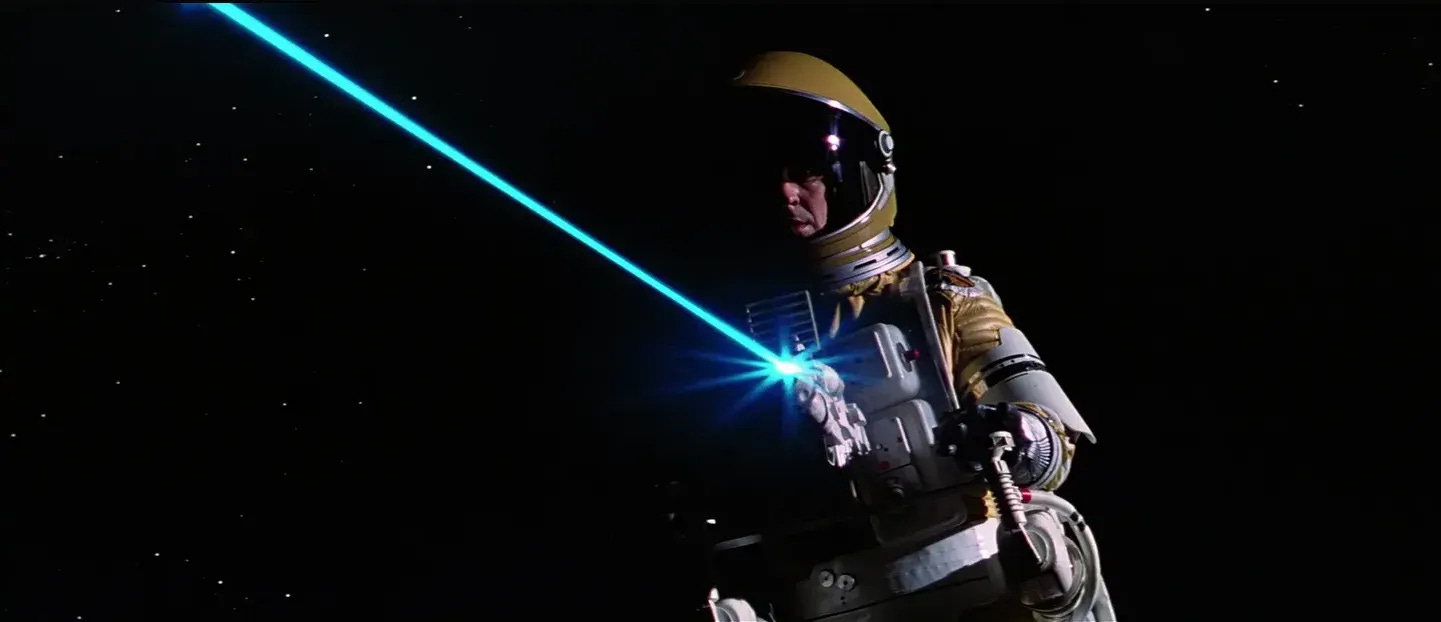
And talking of things past, Moonraker is the very last gasp of the Ken Adam Bond Villain Lair. Adam’s set is, of course, splendid, with its huge Aztec sculptures in moulded fibre-glass and the mechanised lift-bridge over a python or shark-infested pool, but by 1979, the potted palms and the tropical waterfalls, the plastic rocks and the yellow Mini-Mokes, the jumpsuits, Flash Gordon helmets and monorails, were, surely, curiously dated, a thing of the past? Like Thunderbirds (1965-1966)? And it was Ken Adam’s last outing for Bond. As I think, it was for Shirley Bassey, whose John Barry Moonraker theme, alongside the Maurice Binder titles, has to be one of the better Bond title songs, certainly an improvement on Sheena Easton’s track for For Your Eyes Only (1981). And it was also the last appearance for Bernard Lee’s M. Lee died in 1981, to be replaced by lookalike Robert Brown in Octopussy (1983).
So it’s two cheers for Moonraker (1979). Or perhaps, one and a half. For Moonraker is End of an Era, Old School 007. The last gasp of the Bondian Old Guard: ‘Where all the other Bonds end… this one begins!’ Which, by 1979, with the onset of the Thatcherite 1980s, was beginning to look decidedly long in the tooth, despite Eon’s attempt to conquer space. The 1960s vibe was out of fashion, too, only to be revived by twenty-something trendies and media-types in the retro 1990s. That said, it is one of the better Roger Moore Bonds. The man still had it. Which gives hope for those of us on the wrong side of fifty.
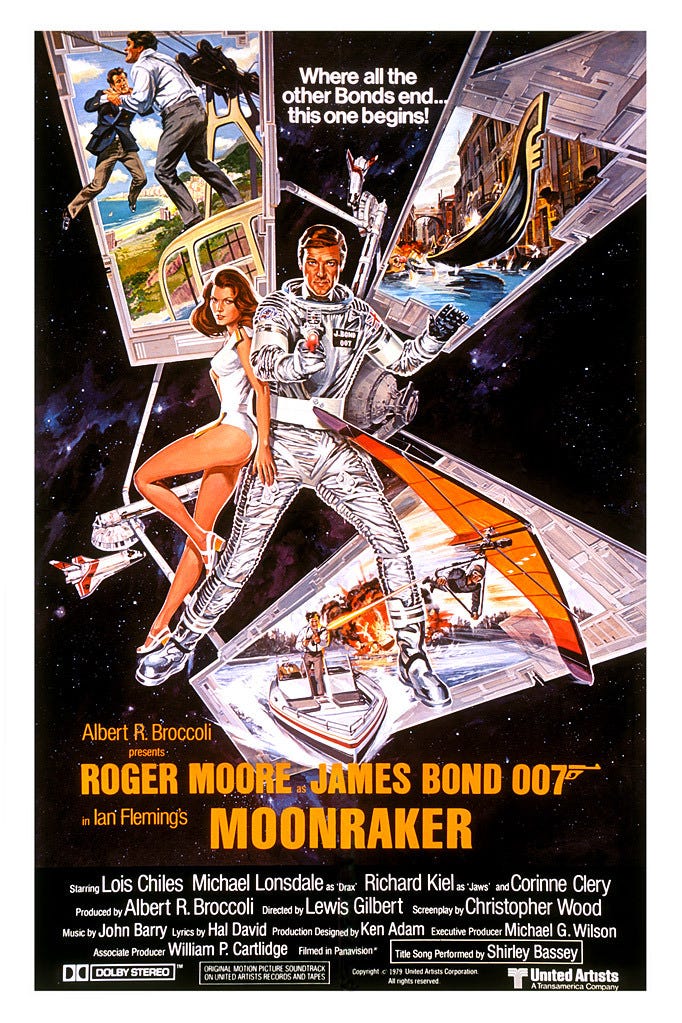
I watched Moonraker (1979) on Amazon Prime Video, and it’s also available on DVD and Blu-ray in various Special Editions.
A big thank you to all of you who have subscribed. How are we doing? Time for a recap. I began Luke Honey’s WEEKEND FLICKS. Cinema for Grown Ups, back in December 2023 — inspired by those vintage indents for London Weekend Television. That feel-good feeling on a late Friday afternoon when sensible, worthy old Thames Television handed over to the racier LWT. My bright idea (which, like Archimedes’, occurred to me in the bath) was to recommend two films over the weekend, with the rule that all films should be readily available, either on DVD or, preferably, as instant downloads. It’s very much a personal view. Old films have brought me a great deal of pleasure over many years, and I’m hoping I can inspire you to watch something you may have forgotten about, or sometimes, might not even have come across. As most of these films are no longer shown on television, the urge becomes more pertinent.
We’re now heading for 1,600 subscribers. It’s bloody hard work (7.00 am sharp, a crawl to the computer, a cup of strong black coffee and calluses on my fingers), but I enjoy it immensely. And there are now well over 200 films in the WEEKEND FLICKS. archive.
So what do you get? Two possibilities on WEEKEND FLICKS: ‘Paid-for’ subscribers get an extra, exclusive film recommendation every Friday morning, plus full access to the complete archive. It costs £5 a month (or £50 a year) — a bargain, frankly, when you compare it to a few cups of coffee, a packet of semi-legal gaspers or a pint of the fizzy stuff in a pub. ‘Free’ subscribers get access to the Sunday newsletter, plus the ‘free subscriber’ films in the archive. Either option is a good bet.
Really enjoyed that, though, wild horses could not drag me to a viewing. Like you, I rather love the novels, but the movies, even the early ones, are really not worth the bother of watching any more, if they ever really were.
A great summation, Luke, of this end of an era (two eras, perhaps, if we count Roger and Sean as a hybrid 'one') for Bond, though it would be five years and two more 007 outings for Moore before the license to thrill passed into the hands of a younger man who was not so intrinsically linked to Fleming's original books.
It is, though, one of my least favourite Bonds, Lois Chiles and Michael Lonsdale notwithstanding, as it seemed so obviously to pander to the moronic herds of Star Wars casualties who would watch anything if it had any kind of tenuous 'space' component.
Richard Kiel's Jaws was much more effective as a villain than as an ally of Bond's, and his inclusion here smacks of desperation and a dire lack of imagination from the Eon team.
But it has a Barry/Bassey/Hal David (!!) song combo that does what every great Bond song should do, ie provide the aural backdrop to Maurice Binder's fabulous titles, which are very often better than the films they introduce!
And, yes, Ken Adam, too.
But Roger looks flabby here, even more so than he does in 1985's A View To A Kill, when he really is way too old for this malarkey, so it was very disappointing for me.
But Timmy was limbering up, so there was hope in the new day dawning...ha-ha!