
Waterloo (1970)
Your Majesty! The monster has escaped from Elba!

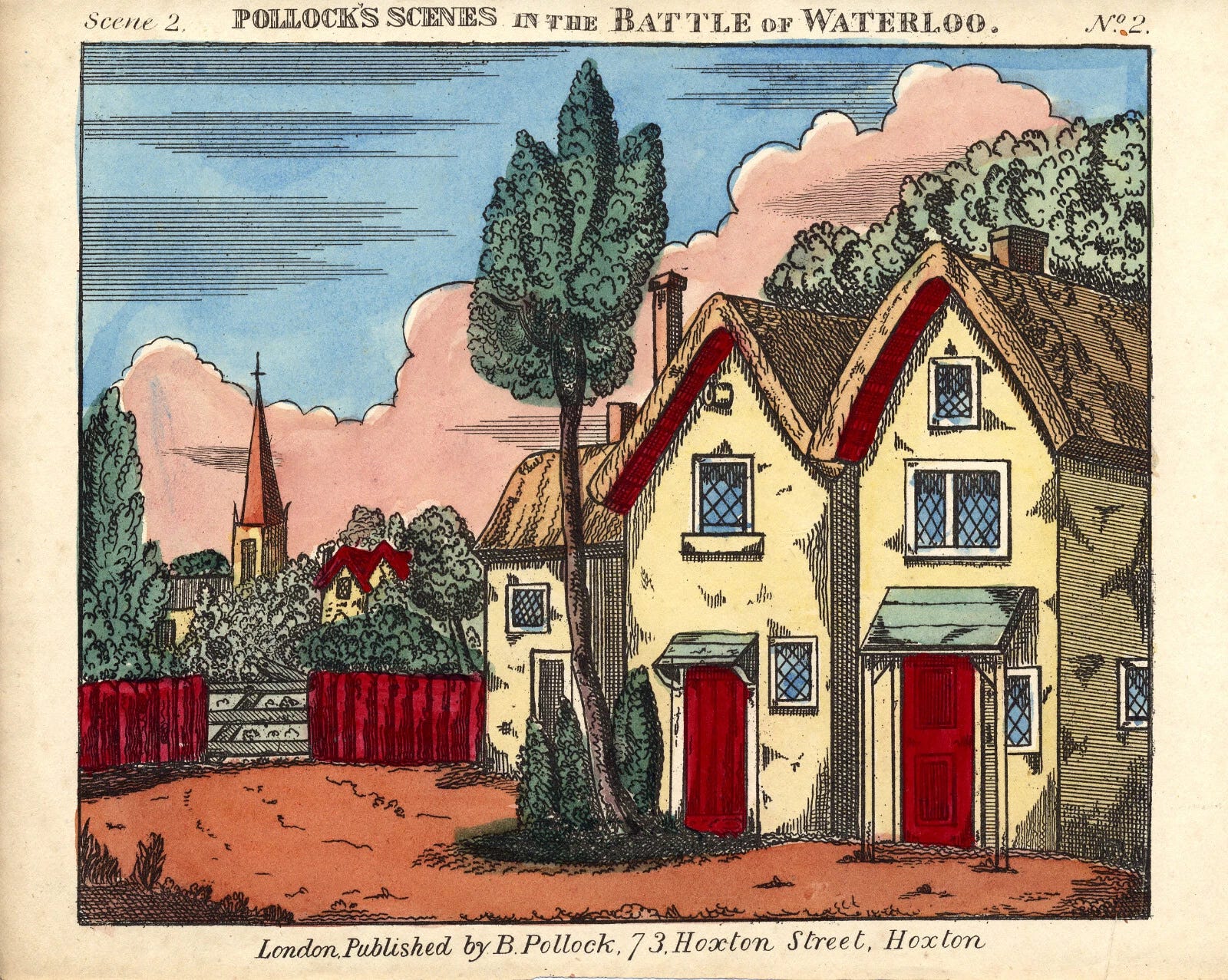
Lunching, yesterday, at the excellent King William IV public house in Hailey, South Oxfordshire — in the foothills of the Chilterns — the rolling hills, fields, copses and woods reminded me of the Waterloo battlefield, found, of course, in Belgium (in 1815, then part of the United Kingdom of the Netherlands) — or, at least, in my fevered romantic imagination: fuelled, I suspect, by the Victorian toy theatre sheets for The Battle of Waterloo (1842), with their thatched gingerbread cottages (lattice windows and heart-shaped shutters), hills, taverns, churches, hayricks, fences, rivers and stiles. An imaginary toy Biedermeier landscape, based partly on truth — sort of — but on visiting the actual battlefield itself, contained within a relatively small area of three square miles, you will find that the original landscape has changed; dug up in the 1820s to create the Butte du Lion, a huge mound topped by a bronze lion. A pity, as the slope to Wellington’s ridge on the Brussels-Charleroi road would have been much steeper than it is today.
The weather plays its part in the romance, too, as Dr. Matthew Genge of Imperial College argued in his fascinating paper of 2018 (on the electrostatic levitation of volcanic ash). On the 10th April 1815, Mount Tambora, on Sumbawa in the Indonesian archipelago, erupted, spewing vast quantities of charged volcanic ash into the atmosphere. Which may explain the unseasonably wet weather of 1815, and the ‘Year without a Summer’ of 1816, which, as we have seen in previous posts, provided a suitably stormy backdrop for Byron’s house party at the Villa Diodati: the birth of Mary Shelley’s Frankenstein, a suitably Gothic subject for several books and films.
Still, visiting the real Waterloo is a fascinating experience. I’ve been there twice. It was terribly exciting. The first on a happy driving tour of the ‘Graveyard of Europe’, i.e., France, Belgium, and Germany — destination: Heidelberg — with Venetia, before we got hitched. And there was the La Haye Sainte! Just like my Airfix kit of 1974! And Hougoumont! There’s a muddy Land Rover tour, which takes you down a sunken lane and then up onto the middle of the battlefield, to the exact spot where the 42nd (Black Watch) formed squares to meet the charge of the French cuirassiers. It’s absolutely fascinating.
Venetia, for some reason, is less enamoured. Her idea of fun is a Samantha Sung dress or a pair of Roger Vivier shoes à la Belle de Jour, although she was amused by the re-enactors. The spectacle of a vertically challenged, bespectacled Captain Mainwaring-type, dressed as Napoleon, leading his men past the Belle Alliance. With his ‘wife’ (?) dressed as a vivandière (or camp follower), trailing in the dust. Or at least, I hope she was a camp follower. The mind boggles.
My late father had this splendid illustrated coffee table book, Waterloo (1975), by one Commandant Henri Lachouque, full of interesting pictures, photographs, diagrams and maps, and evocative 1970s fonts, over which I spent many happy hours in the summer holidays, on the sitting room sofa. Recently, I found a replacement copy on eBay, my mother having chucked out the sacred work in one of her organisational purges. For the Napoleonic/Waterloo thing is very much a part of the 1960s/70s zeitgeist, a recurring theme amongst these pages. Think the Brandy of Napoleon, or the swinging scarlet tunics of The King’s Road.
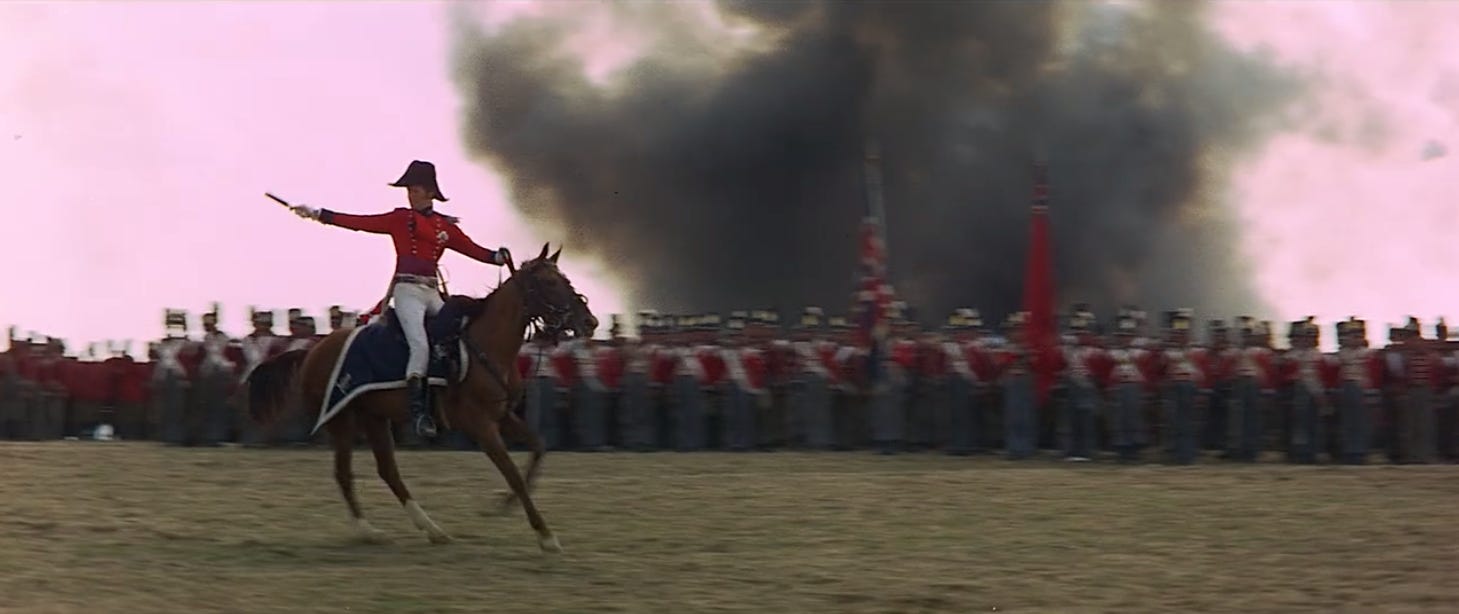
Which takes us to Dino De Laurentiis’s magnificent Waterloo (1970), directed by Sergei Bondarchuk and starring the Soviet Army. A film I have seen many, many times. Watching it again, last night, and having recently seen Ridley Scott’s disappointing Napoleon (2023), which has the Emperor leading a cavalry charge at Waterloo (wot?), it now occurs to me that Waterloo (1970), actually, is a rather good film in itself, despite its various flaws, and its nostalgic fanbase based on countless rainy or sunny Bank Holiday Monday screenings.
The Hundred Days is, of course, one of the most exciting, or certainly one of the most dramatic episodes in 19th century history. Napoleon (Rod Steiger) escapes from the island of Elba, lands near Cannes, and marches north towards Paris, collecting supporters and turncoats along the way, as the Royalist army goes over to Napoleon, one regiment after another, like a collapsing house of cards. Marshal Ney (Dan O’Herlihy), having previously boasted to Louis XVIII (Orson Welles) that he “will take Napoleon back to Paris in an iron cage”, switches sides and joins Napoleon. Talk about hedging your bets! Which means that Napoleon and his sizeable, but hastily formed, army can only be stopped by the allied armies of the Duke of Wellington (Christopher Plummer) and Field Marshal Blücher (Sergo Zakariadze), somewhere along the road to Brussels. And that place was Waterloo. Or at least, somewhere in the rolling countryside, leading up to the ridge at Mont-Saint-Jean on the Brussels-Charleroi road, about two miles south of the village of Waterloo, which gave the battle its name.
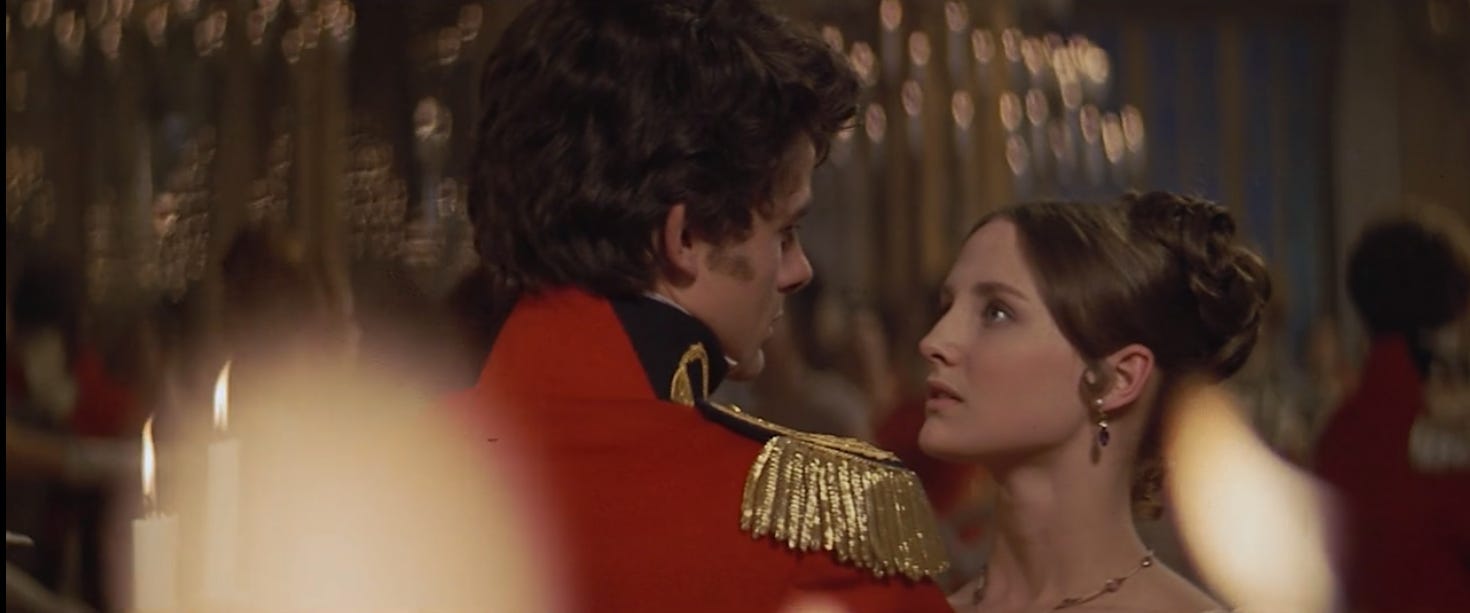
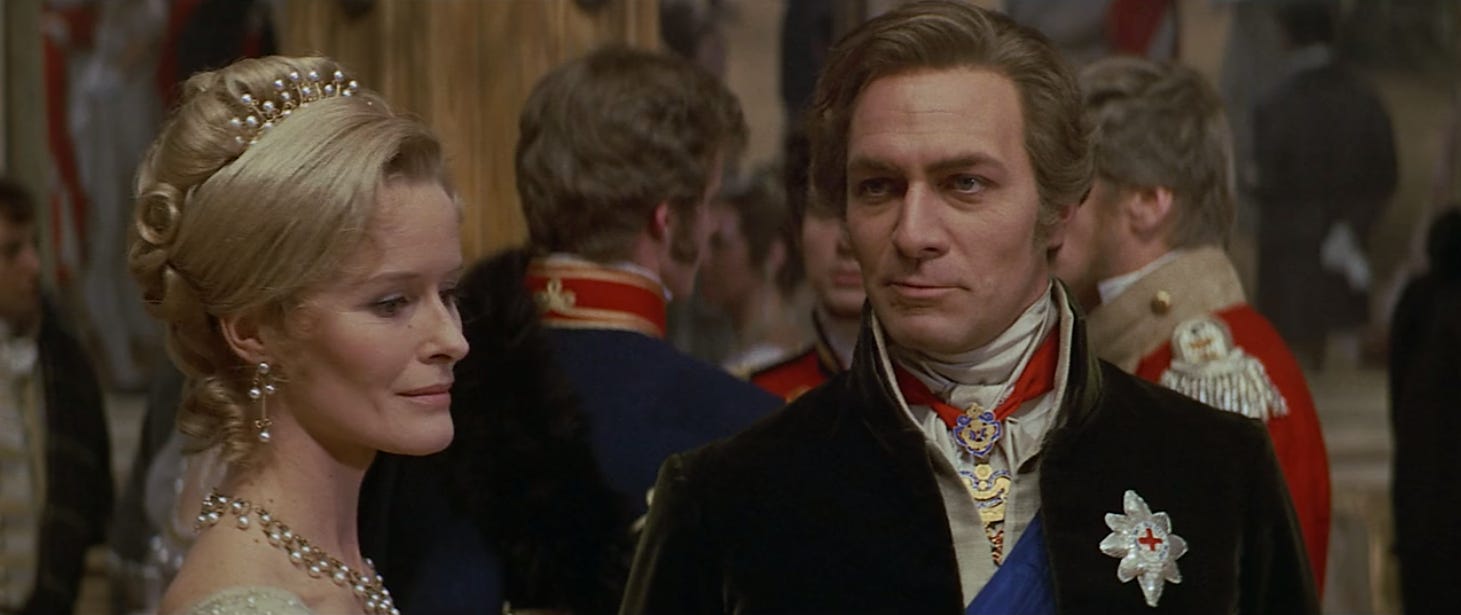
The film has been criticised for the first half hour or so. Too historical, too talky, too slow — but I love all that stuff. The crunch of jackboots as the treacherous Marshals stamp across the marbled floors of Fontainebleau, like a television commercial for Courvoisier cognac. Rod Steiger’s megalomaniac Napoleon raving in his bath. The jubilant, revolutionary crowds on the staircase of the Tuileries, waving the tricolour. And the Duchess of Richmond’s ball! I adore that sequence; it's one of the highlights of the film. Handsome Virginia McKenna hamming it up as the Duchess of Richmond, Christopher Plummer’s quip-a-minute — it’s like the Wellington listing in the Oxford Dictionary of Quotations. The skirl of the Gordon Highlanders’ bagpipes. Nino Rota’s fabulous soundtrack, especially the Waterloo Waltz, the thunder, lightning and rain, as gusts blow open the French windows and the chandeliers splutter, as the brave young officers in their splendid uniforms say goodbye to their pretty, tearful girlfriends, many of them never to return. The gentlemanly sang-froid of the British officer class, “officers obliged to their ladies will finish their dances.” Like Drake’s game of bowls, this is the stuff of legend, exactly as it should be. Even if the real Duchess of Richmond’s ball seems to have taken place in some sort of barn or modest carriage house.
Churchill’s favourite historian, Sir Arthur Bryant (alas, now discredited by serious historians as much for his Nazi sympathies as for his Whig Interpretation of History), is good on this. Here’s his evocative, over-romanticised depiction of Regency Society in the Age of Elegance (1950):
There were breakfast parties in pastoral mansions among the Middlesex meadows and Surrey woods, water parties in carpeted boats with bands and deliberately coloured awnings and Gunter’s choicest suppers, fête champêtres in the gardens of aristocratic palaces, masqued balls and music assemblies and dances where, after endless quadrilles and suppers in which every delicacy was served under Grecian lamps and festoons of exotics, white gowned, high bosomed graces relaxed, blushing in the arms of tight-pantalooned cavaliers, in the sensational new German dance, the waltz.
The Duchess of Richmond’s ball scene reads like a passage from Bryant. It’s how history should have been, in our romantic imaginations, rather than how it actually was. And none the worse for that. And Christopher Plummer’s Wellington, again, strikes me as entirely right. The more I read up on Wellington, the more I admire the cut of his jib. Very much a Ladies’ Man, Wellington had an eye for intelligent, good-looking literary young women, to whom he wrote letters (poor Kitty!). Cool as a cucumber, brave under fire, a man of integrity and as hard as steel, Wellington had an urbane, dry, cynical wit. Unlike Nelson, who was loved by his men, Wellington gained more respect than adoration: a commander who executed looters at the drop of a cocked hat, yet repressed his sensitivity and artistic side, weeping at the senseless death, carnage and destruction of a battlefield after the event. “Nothing except a battle lost can be half so melancholy as a battle won.”
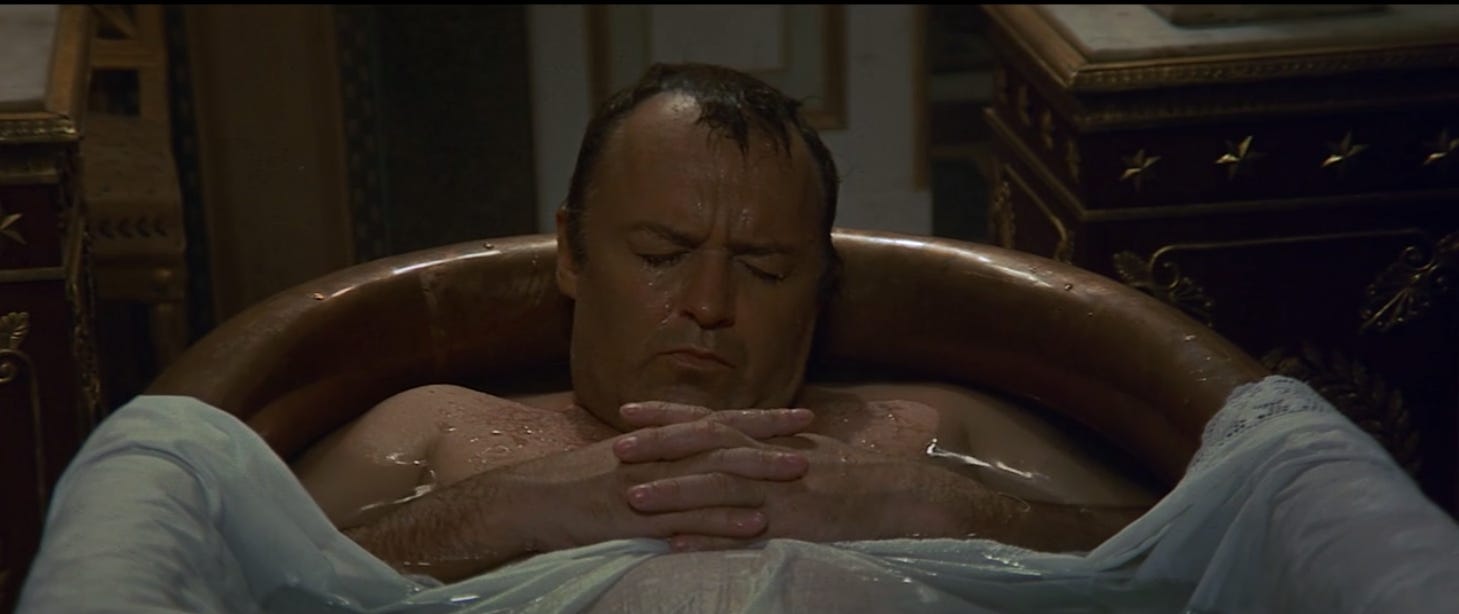
And Rod Steiger’s Napoleon is terrific. A megalomaniac visionary. Swinging from hysterical fury on the one hand, to a controlled, magnetic and dangerous charisma on the other. Plagued by ill-health, genius merging into madness. Like Hitler, in the brilliant Downfall (2004), controlling phantom armies on a map. It’s a wonderful foil to Wellington’s sang-froid. There have been many historical interpretations of Napoleon, so it’s useful to work out where you stand. Correlli Barnett in Bonaparte (1978) has the Emperor as a dodgy, jumped-up Corsican gangster, dishing out kingdoms and principalities to his immediate family, while Andrew Roberts in Napoleon the Great (2014) sees Bonaparte more as a great administrator and legislator, a child of the Enlightenment, an authority backed by legitimate plebiscites.
But ultimately, it’s the sheer spectacle and scale of Waterloo (1970) which wins the day. A significant military operation in its own right. Some 17,000 men of the Red Army in period costume, with God knows how many horses. Soviet engineers, apparently, bulldozed two hills, constructed five miles of roads, and transplanted 5,000 trees. And the charge of the Scots Greys has to be one of the most spectacular cavalry charges ever consigned to celluloid, alongside Tony Richardson’s The Charge of the Light Brigade (1968), although I am very aware that standards in animal welfare have moved on considerably since 1970, and twenty-two seconds of footage have subsequently been cut from Waterloo’s British release. And my only other quibble, apart from the dodgy riding sequences (clearly filmed on some sort of mechanical horse contraption) and the anachronistic bolt-action Russian Mosin-Nagant rifles, is the landscape. Waterloo (1970) was shot at Uzhhorod, in dusty, dry, arid Ukraine. There are mountains in the distance. Despite the copious use of filmic mud in the foreground, Waterloo (1970) sometimes looks as if it were filmed in a desert. The rolling hills of the Flanders countryside, the toy Biedermeier landscape, has been replaced by something far more exotic. But hey, the film was made before the advent of the kidult’s CGI. It’s real life. It’s the real deal. And we must salute it for that.
I watched Waterloo (1970) on Amazon Prime Video, and it’s also available on DVD and Blu-Ray. Right. Where are we? That was Film No. 200 and Something in the official WEEKEND FLICKS. Cinema for Grown Ups Archive. And by now you should know how it works. Friday’s post is for the Paid Subscribers (£5 a month or £50 a year). An elite coterie of discriminating cinephiles. Paid subscribers also get access to the entire archive, which goes all the way back to when we started, in December 2023.
Sunday’s post is free and open to all. So two film recommendations to get your teeth into over the weekend. Time to sit back, relax, mix a cocktail — and watch an old film.
And on Wednesday mornings, we revisit a post from the archive. That’s really for the benefit of new subscribers, who may not have seen my older posts.
Plummer even looks something like Wellington!
I haven’t seen it in decades …
Agreed about the Duchess of Richmond’s ball … it’s beautiful in itself and a necessary initial walking pace toward the battle.
A personal favorite of mine as well, as a student of military history, wargamer, and a reenactor myself. I also have a prized hardback copy of costume designer Ugo Pericoli's book 1815: The Armies at Waterloo (supplementary text by Michael Glover and an Introduction by Elizabeth Longford). The movie's scale helps make up for some of the justly cited flaws and the performances of Steiger and Plummer - and Sergei as the Prussian Blucher (I'll shoot any many I see with pity in him") play nicely off of each other. And Orson Welles as a rather calm and unalarmed King Louis). There was a recurring rumor of a 4 hour version that I spent part of my time in Russia investigating without finding either hide or hair of it, reducing it probably to one of those mythic cinematic creatures that some people wished were true.