
Callan (1974)
'Hotter than Hell... Bolder than Bond!"

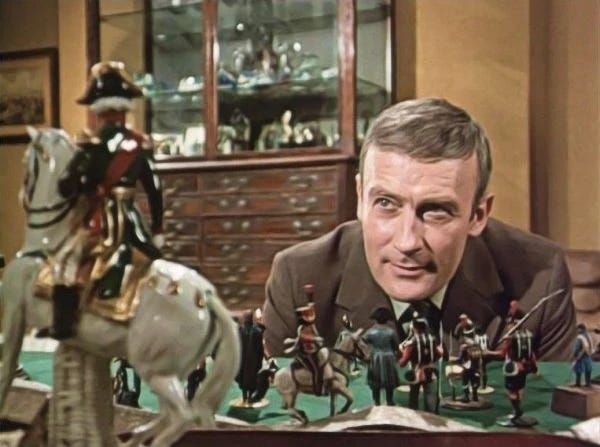
And now for something different. There’s nothing like a 1960s or 70s spy thriller, is there? In a previous post, we explored the world of The Ipcress File (1965). Len Deighton’s anti-hero, Harry Palmer, is, of course, played brilliantly by Michael Caine. Palmer was a sort of anti-Bond (altho’, Deighton, I think, denied it). But while Bond holds Her Majesty’s commission in the Senior Service, Palmer scrapes the rank of Sergeant in the Intelligence Corps. Bond wears a Walther PPK; Harry Palmer wears National Health Specs. And if queeny old 007 requires his housekeeper to boil the speckled brown egg of a Maran hen for three-and-a-half minutes precisely, then Harry Palmer slips Mozart’s Prague onto his trusty record player and whips up an Armagnac soufflé.
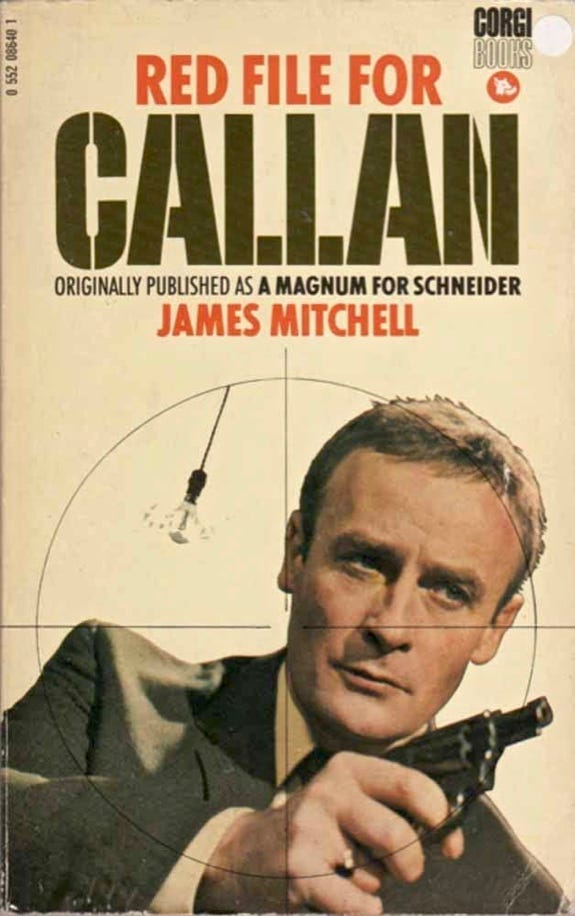
James Mitchell’s David Callan (Edward Woodward) beats a similar path to Palmer, if a connoisseur-ish interest in wargaming and military modelling replaces the Mozart and Champignon Sauce — but more of that later. Callan, the ITV television series, ran from 1967 to 1972 to significant acclaim. This was followed, in 1974, by Don Sharp’s film, based almost directly on the pilot episode A Magnum for Schneider (1967) — plus a further film (for television), the risibly named Wet Job (1981).
Callan is a jaded killer, a reluctant if ruthless assassin employed by a special assassination section of British Intelligence. Like Harry Palmer, Callan is from a working-class background, an ex-British Army NCO with a criminal record. Which allows for lots of good old British class conflict, with both Palmer and Callan pitting their wits against devious, superior Clubland: the pin-stripe suit, velvet collar, and the Old School Tie. This became a familar trope in spy thrillers of the time, enhanced especially, by the debacle of the ‘Cambridge Five’; in America, the Watergate scandal of 1974; and the unmasking of distinguished art historian, Sir Anthony Blunt, as a Soviet double agent in 1979, sheltered previously by an establishment cover-up — a theme which continued throughout the 70s and into the early 80s.
In Who Dares Wins (1982), an Old Harrovian Cabinet Minister plots anarchy on behalf of the Soviets, and in The Professionals (1977-1983), Major Cowley’s CI5 operates outside the law, which means the ‘Establishment’. And Anthony Sampson’s The Anatomy of Britain (1962), The New Anatomy of Britain (1971), and The Changing Anatomy of Britain (1982) emphasised the hidden influence of this Establishment. There’s a sense — in the spy thrillers of the period — of government conspiracy, of cover-ups at the top, the subterfuge of Clubland and the Old Boy Net, of treachery in High Places. That the ordinary man on the street — the Palmers and the Callans — is inevitably doomed to failure, for the Establishment will always win in the end.
Fleming’s Establishment is very different. If Commander Bond’s not officially a member of Blades, M certainly invites him there to play Bridge, and he clearly cuts the mustard. And if M’s a bit crotchety at times, at the end of the day, he’s always on Bond’s side. For Bond is the Establishment. In contrast, in Callan (1974), the ‘Section’ operates from the grimy confines of a Scrap Metal yard, an outfit with all the integrity of a scrap metal merchant — even if the office of Callan’s boss, Hunter (Eric Porter), is decorated with a ubiquitous leather upholstered armchair and George III mahogany desk. And the Section, true to 1970s Britain, is run on the cheap. No Ken Adam set-up for this one. Apart from Hunter, there’s Meres (played by the elegant Peter Egan), a vicious Old Etonian and former Guards officer; a cut-glass secretary behind a desk (Veronica Lang), and apart from Callan and a bare light bulb, that’s about it.
During the 1970s, the British film industry struggled. American funding and/or distribution for and of British cinema, which produced films along the lines of Those Magnificent Men in Their Flying Machines (1965) (20th Century Fox), The Charge of the Light Brigade (1968) (Universal Artists) and If…. (1968) (Paramount), had dried up. Dwindling audiences didn’t help either. In 1974, the biggest British hit was the saucy escapades of Robin Askwith in Confessions of a Window Cleaner (1974), which says much about Britain at that time. And direct competition from television produced naff television spin-offs: Please Sir! (1971), On the Buses (1971), Dad’s Army (1971), Are You Being Served (1977), Sweeney! (1977) — and my favourite Father Dear Father (1973), (admittedly, an acquired taste), starring the amusing Patrick Cargill as a suave fifty-something divorced thriller writer, with two plummy King’s Road dollybird daughters, a Hampstead house populated with antiques and a St. Bernard called H. G. Wells; and described by The Monthly Film Bulletin in the following terms:
With its scatterbrained but essentially "nice" bourgeois family who appear to encounter the working classes only in the shape of comic chars and milkmen… The plot limps from one cliché to another via the familiar devices of crossed purposes and mistaken identity, while the doggedly trivial banter of the dialogue becomes increasingly wearing as the film progresses.
Still. It strikes me as bizarre that anybody in 1977 might actually pay to watch Are You Being Served?, in which the staff of Grace Brothers holiday on the Costa Plonka (gettit?). I mean, you couldn’t make it up — a work described by DVD Verdict as ‘guilty of violating almost every law of comedy and film’. But they did, flocking to the Big Screen in reasonably large numbers, and the picture was, I quote, “fairly successful.”
But back to Callan (1974). The Section lures a retired and jaded Callan back into service, with the instruction to assassinate Rudolph Schneider (Carl Möhner), an urbane German arms dealer and former Wehrmacht officer, and a connoisseur of the wargame. There’s a nice Country House on the Thames (Shepperton Manor), and an appealing girlfriend: the splendid former Bond Girl, Catherine Schell, aka the Baroness Katherina Schell von Bauschlott. Callan’s a wargamer too. Kinda ironic, considering he kills people for a living and hates his job. But then the appeal of wargaming is that it’s one step removed from real life — all the panoply of war, the glamour of the Napoleonic uniforms, the glitter and the spectacle. A useful vehicle for those of us with Napoleonic fantasies.
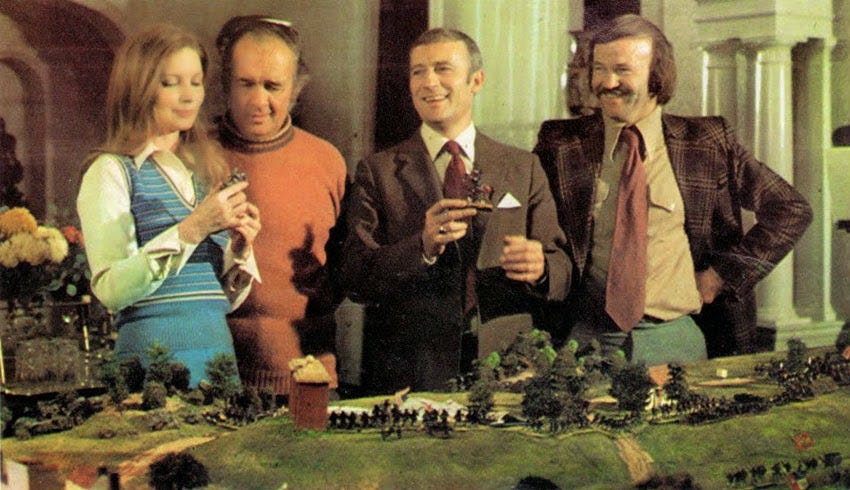
Some years ago, before we were married, I drove across the Graveyard of Europe with Venetia — destination Heidelberg — in an open Saab 900 Turbo. It was my first proper driving holiday, and I loved it: those long straight French roads, punctuated with poplars; the empty, dusty countryside, the Gallic logic of the road network, and, of course, the food found in local restaurants, which, despite current opinion, is still pretty good. We stopped off at the old Waterloo battlefield, in Belgium, to be met by a troupe of re-enactors, led by a portly, bespectacled man dressed as Napoleon, most probably an accountant (the Belgian Captain Mainwaring), marching his men from La Belle Alliance to La Haye Sainte, which those of a certain vintage will remember from their Airfix days.
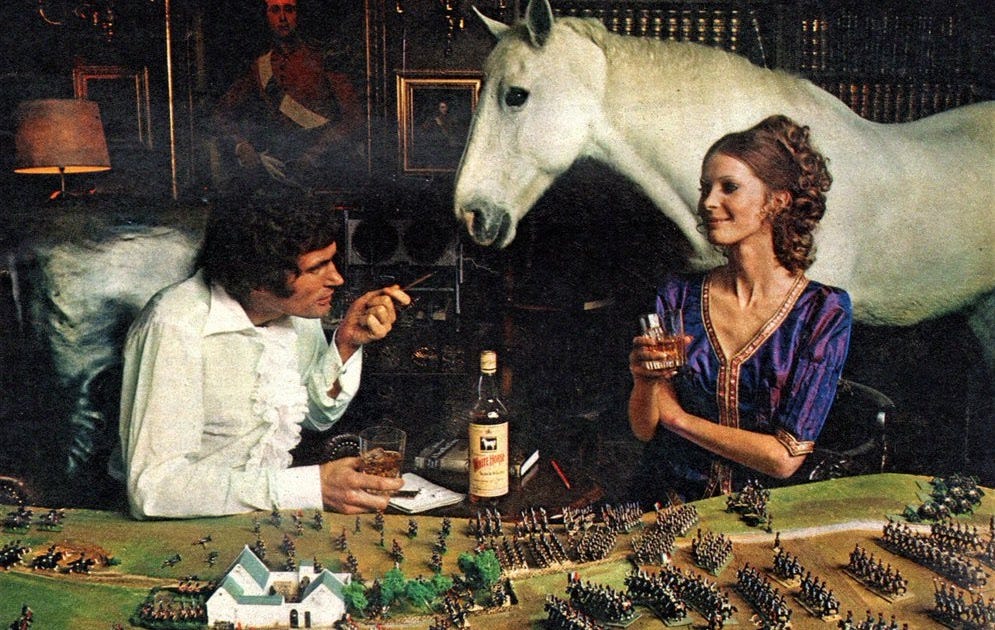
For it’s easy to laugh now, but back in the late 1960s and 1970s, wargaming and all things militaria — especially Napoleonic— were incredibly fashionable. I have an entire run of Discovering Antiques (1970), a marvellous part-work, kept in a set of volumes bound in gilded and glorious kidron, and it’s a useful barometer of early 1970s taste — packed with suits of armour, toy soldiers, rare medallions, swords, flintlock pistols and spiked pickelhaube. Think The Brandy of Napoleon. Even White Horse Whisky joined the club, aping the old school glamour of cognac advertising, as you can see in this magazine ad below. Peter Gilder of Hinchcliffe Models provided the Gettysburg battlefield in Callan (1974), and I suspect he was also responsible for the Waterloo setup in the photograph below. The girl looks a bit like Catherine Schell.
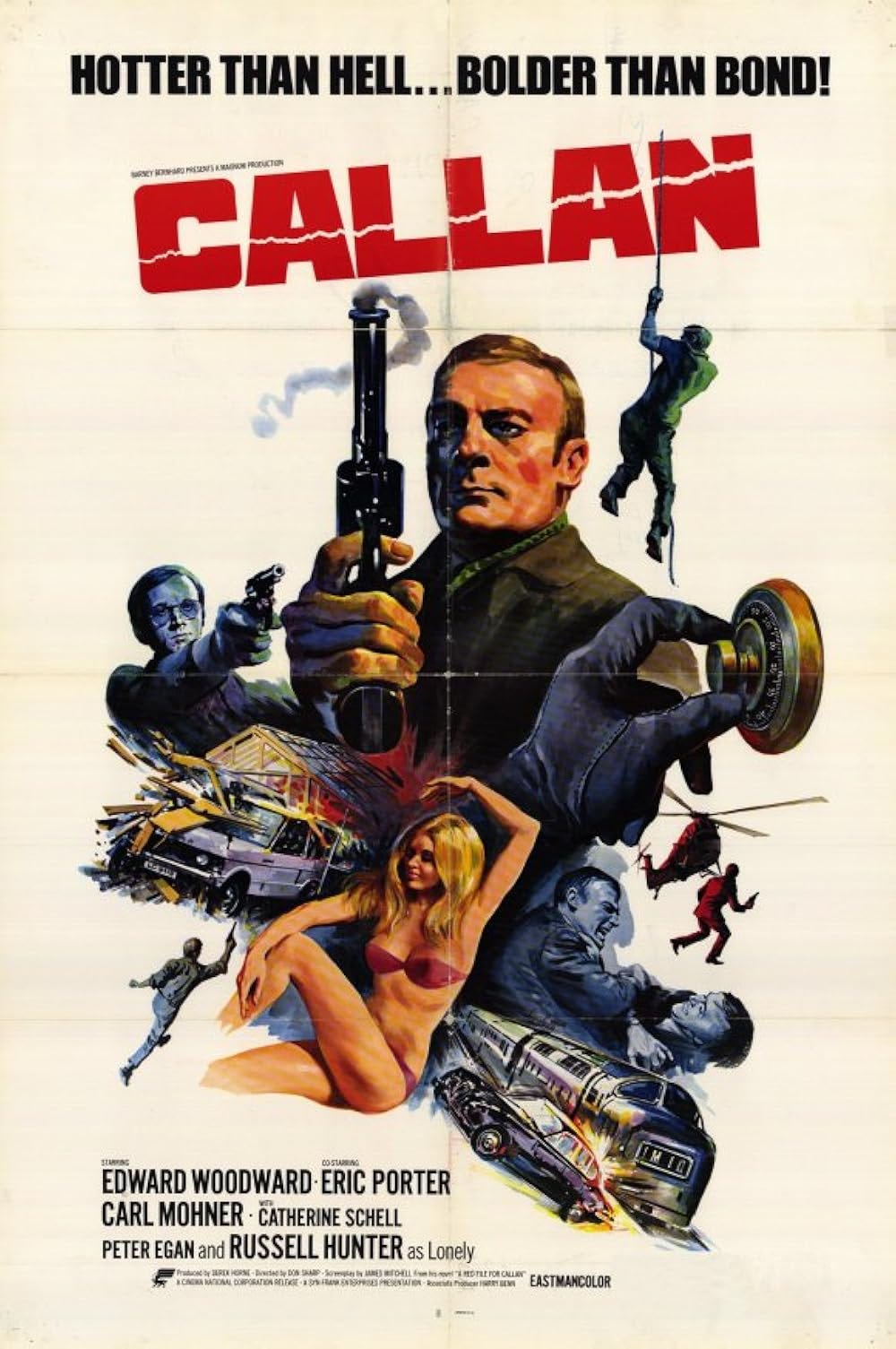
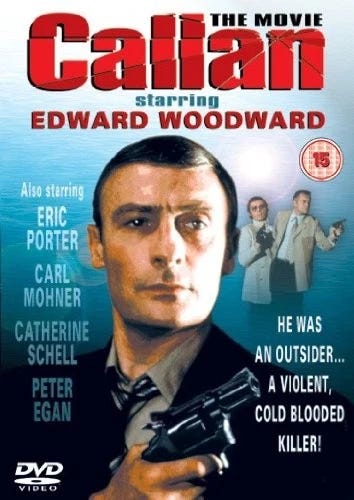
I like Callan (1974). Even if we’re in classic Don Sharp territory, or maybe because we’re in classic Don Sharp territory. Sharp’s filmography includes Rasputin the Mad Monk (1966), The Brides of Fu Manchu (1966), Dark Places (1973), an episode of Hammer House of Horror (1980) and The Thirty-Nine Steps (1978), starring Robert Powell dangling from the dial of Big Ben. And there’s a cracking cast: Edward Woodward, Peter Egan, Eric Porter, Catherine Schell, Kenneth Griffiths and Russell Hunter as Callan’s odiferous little friend, ‘Lonely.’ Plus, Obersturmführer Clifford Rose, as a sinister doctor in yet another Old Etonian tie. Incidentally, the sexed up ‘Bolder than Bond’ film poster (pictured at the top of the post) doesn’t actually bear any resemblance to the film. I don’t remember an SAS-style helicopter drop, and Catherine Schell, alas, doesn’t appear in a bikini. But there’s lots of raw violence, a cracking car chase, between Callan in a white Range Rover (amazingly modern) and Schneider in a Jaguar S-type, and some nice London location work (how gritty it looks!), including a snazzy mews house in Earls Court and a steak restaurant on the River, actually filmed at the Mermaid Theatre in Puddle Dock. Plus a wargaming sequence, which, if it doesn’t have you gripping your leather armchair in excitement, you might find useful as a cure for insomnia.
I watched Callan (1974) on YouTube. Alas, it’s not available on Amazon Prime Video, altho’ there is a DVD, and for those of the Luddite persuasion, a VHS video tape.
Right. That was Film No. 170 in the WEEKEND FLICKS. archive. And by now, you should know the form. Paid subscribers (a bargain £5 a month, or £50 a year) get two film recommendations every weekend (on Friday and Sunday mornings) plus access to the entire archive. Free subscribers get a snippet of the Friday post (nothing like dangling that metaphorical carrot) and the Sunday recommendation. A film doesn’t necessarily have to be ‘good’ (i.e. rated by the critics), but it does have to have something about it. Which makes it worth watching. And there’s one important rule. Every film we discuss needs to be readily available. Preferably via immediate digital download or via DVD, which can be bought easily online.
I hope you enjoy Callan (1974). Another Sunday Evening Special. And as it’s Callan, it’s probably a pint of London Pride for this one. I will be back on Friday with another Weekend Classic. Until then…
Callan the series was classic British television. It was on Australian tv late on Friday nights along with the Two Ronnies and Dave Allen. Those were the days.
Thanks for this post, which prompted me to watch the film again last week. I had seen it when it first came out and thought it nowhere near as good as the TV series, of which I was a huge fan. Rewatching fifty years on, I really enjoyed it. It did however make me think:
1. How completely Edward Woodward owned the role. (I never really got over subsequently seeing his singing on 'The Good Old Days').
2.What a brilliant character, and how well portrayed, Lonely was.
3.How Peter Egan was nowhere near as impressive a Toby Meres as Anthony Valentine.
4. How unrelentingly grim 1970s London was.
5. What a mystery it remains that Dave Prowse wasn't allowed to be the voice, as well as the body, of Darth Vader.
A wonderful evening of nostalgia!